How to discriminate between eVTOL investments
There are 2 key factors specific to eVTOL companies which can be relied upon to accurately assess and compare their potential for success with their technology concepts:
- Certification: whether / when they will be able to operate in commercial airspace,
- Operating Margins: the relative cost per operating flight hour (CpFH) and reliability of the system and how they compare to potential competitors.
Certification: the key systemic risk eVTOL investments
Certification is the major systemic risk for eVTOL / UAM companies that investors must quantify and understand. Because eVTOLs are ‘safety-critical’ systems they require certification from regulatory bodies (the FAA in the US, EASA in the EU) that ensures they are inherently safe and reliable before being legally allowed to operate in commercial airspace.
If you don’t get your platform certified you cant start to generate revenue.
Based on estimates from established commercial aerospace players, the cost of certification for an eVTOL could range from $0.5-1.5bn.
These estimates reflect the engineering process, schedule and associated costs of identifying, analyzing and mitigating the potential technical risk in the system. Additional complexity in this calculation comes from the lack of certainty for certification requirements for eVTOL – the regulatory bodies are still formulating the ‘rules’ to which companies will need to adhere for autonomy and use of AI.
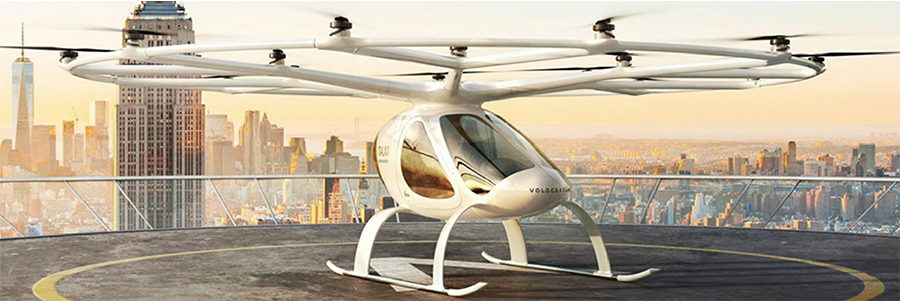
Source: Volocopter
Finally, the standard on which certification is based ( “ARP4761 – Guidelines and Methods for conducting the Safety Assessment process on Civil Airborne systems and equipment”) is shortly to be updated with a requirement that ‘model-based analysis’ is used to support the process.
What is surprising is that most eVTOL companies have not raised the level of funds that would cover the estimated cost of certifying their systems
– and so this becomes a key question for VCs to consider: does the company understand the costs and schedule associated with obtaining certification of their systems? Does the company have the experienced resources and tools to conduct the certification process (some form of Certification Readiness metric) and has it factored the cost of the process into its capital raising plans?
Cost of Ownership: the key differentiator for UAM operators
Assuming that the vehicle can be certified, the eVTOL OEM must then convince UAM operators that their platform provides the best commercial return – that it is safe, reliable and its cost of operation will enable them to achieve their targeted operating margins.
Our engagement with eVTOL OEMs to date has demonstrated that they are heavily focused on the development of their technology to meet performance targets (speed, range, payload, etc.). Far less attention has been devoted to establishing the Cost of Ownership (CoO), a figure that is calculated based on the maintenance that is required (service costs, repair costs, spare parts, etc.) and how frequently and effectively it must be performed (typically calculated per flight hour of the system [CpFH]).
The opportunity for eVTOL companies that are still developing their systems, is to factor CpFH into design choices that will reduce CoO – for example by using predictive maintenance (based on the condition of the equipment to trigger service events) rather than scheduled maintenance (where maintenance is performed despite the condition of the equipment). Note that these decisions also impact on the certification process – and again should be considered concurrently with the design, not once the system is in physical testing.

Image Source: Uber Elevate
As the UAM market develops, operators focus will shift from capability to profitability, and those eVTOL companies that are able to use predictive / condition-based maintenance will have a significantly lower cost of ownership that translates into higher operating margins. If the required diagnostics (sensors) have not been engineered into the system during the design phase – predictive maintenance becomes impractical and cost prohibitive.
Can the eVTOL company that you are looking to invest clearly articulate their expected CpFH? Can they demonstrate the engineering processes that they are using to embed the capability for predictive maintenance? If they are not already thinking about it – it could soon be too late.
Summary
The risk / reward equation for VC investment in eVTOLs and UAM is clear – high risk and high reward. Investors looking for those companies most likely to succeed will assess their engineering processes and technology to:
- rapidly achieve certification
- demonstrate a competitive advantage based on Cost per Flight Hour.
Caveat Emptor!

