

Non-equivalent supplier assumptions
Standardise bid inputs so supplier support concepts can be assessed using consistent reliability, maintenance, logistics and cost assumptions.
MADE helps acquisition teams evaluate competing sustainment strategies, reliability assumptions, maintenance approaches and lifecycle cost inputs using a common model-based decision-support framework.
During acquisition, decision-makers must compare competing bids that often promise very different product support strategies. Without a consistent way to evaluate reliability, availability, maintenance, logistics and supportability assumptions, organisations risk making decisions on incomplete or non-equivalent information.
MADE structures bid data within a common analytical framework, helping teams evaluate sustainment concepts, identify risk, test assumptions and compare lifecycle performance against required readiness, safety and cost metrics.
MADE transforms acquisition appraisal from document comparison into model-based analysis, enabling transparent trade studies, consistent evaluation and defensible supplier assessment.
MADE provides a structured decision-support framework for sustainment concept comparison and analysis.
Standardise bid inputs so supplier support concepts can be assessed using consistent reliability, maintenance, logistics and cost assumptions.
Identify risk exposure early by modelling how supplier assumptions affect readiness, downtime, safety and lifecycle outcomes.
Support budget forecasts with technical analysis rather than relying solely on supplier estimates or high-level assumptions.
Support informed negotiation of support arrangements by testing supplier approaches against measurable supportability objectives.
Improve transparency and repeatability by basing evaluation on consistent modelling, simulation and traceable analytical outputs.
Evidence the safety case for each bid using model-based outputs including FMECA, FTA, RBD and RCM analysis.
MADE uses a combined simulation model of the asset to represent each sustainment operating concept. This enables acquisition teams to compare support strategies, reliability assumptions, maintenance effectiveness and lifecycle outcomes in one model-based environment.
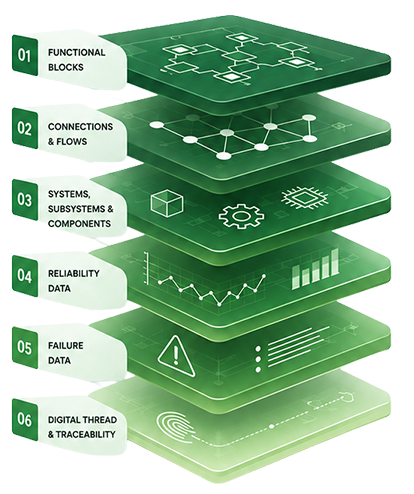

MADE gives acquisition teams a structured way to compare supplier claims, support concepts, reliability assumptions and lifecycle cost inputs using a consistent analytical model.
MADE links acquisition appraisal directly to engineering outputs, helping teams understand how each proposed solution may perform against readiness, safety, cost and sustainment requirements.


With simulation-enabled trade studies, acquisition teams can assess how alternate usage cycles, support models and operational environments affect long-term readiness, sustainment effort and budget exposure.
MADE helps acquisition teams move beyond marketing claims and supplier-specific formats by applying a common model and analysis framework to all solutions.
MADE links acquisition decisions directly to RAMS, safety, maintenance and lifecycle cost evidence.
Compare failure modes, effects and criticality across competing supplier designs and sustainment concepts.
Assess top-level failure events, root causes and safety-critical contributors within each bid.
Compare reliability and availability assumptions across system architectures and redundancy strategies.
Evaluate maintenance effectiveness, task strategies, support effort and sustainment impacts.
Link cost forecasts to engineering assumptions, failure behaviour and supportability concepts.
Test alternate missions, usage cycles, environments and support strategies before selecting a solution.
MADE helps organisations make better procurement decisions for complex, mission-critical systems.
See how MADE supports sustainment concept comparison, bid appraisal, supplier assessment, lifecycle cost evaluation and evidence-based acquisition decisions.
MADE enables acquisition teams to compare competing support concepts, validate sustainment assumptions, assess risk and improve confidence in complex procurement decisions from day one.
Whether you have a specific challenge in mind or just want to learn more, we’re here to help. Fill out the form below and one of our experts will get back to you shortly with insights tailored to your needs.
